


Your support changes lives. Thank you!
Learn More

Post-Traumatic Stress Disorder (PTSD)
Understanding PTSD
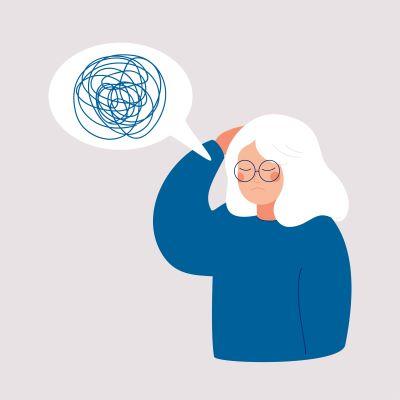
Going through something really scary or upsetting can make you feel a lot of tough things. You might keep thinking about what happened, have trouble sleeping, or feel jumpy a lot of the time. It's normal for these feelings to start to get better in a few weeks or months. But sometimes, they don't get better, and a person might get something called post-traumatic stress disorder, or PTSD for short.
PTSD is when you keep having scary thoughts and nightmares about what happened, try really hard not to think about it, and start feeling really bad about yourself or the world. You might also get easily upset, be super alert all the time, or have a hard time focusing or sleeping.
If these feelings keep going on and make it hard for you to do everyday things, it's really important to talk to a doctor or a therapist who can help you start feeling better.
It's normal to have upsetting memories, feel on edge, or have trouble sleeping after a traumatic event (also called "trauma"). At first, it may be hard to do daily activities you are used to doing, like going to work, going to school, or spending time with people you care about. But most people start to feel better after a few weeks or months. For some people, post-traumatic stress (PTSD) symptoms may start later, or they may come and go over time. If it's been longer than a few months and thoughts and feelings from the trauma are upsetting you or causing problems in your life, you may have PTSD.1
PTSD Symptoms
- Spontaneous or cued recurrent, involuntary, and intrusive distressing memories of the traumatic events (Note: In children repetitive play may occur in which themes or aspects of the traumatic events are expressed.)
- Recurrent distressing dreams in which the content or affect (i.e. feeling) of the dream is related to the events (Note: In children there may be frightening dreams without recognizable content.)
- Flashbacks or other dissociative reactions in which the individual feels or acts as if the traumatic events are recurring (Note: In children trauma-specific reenactment may occur in play.)
- Intense or prolonged psychological distress at exposure to internal or external cues that symbolize or resemble an aspect of the traumatic events
- Physiological reactions to reminders of the traumatic events
- Persistent avoidance of distressing memories, thoughts, or feelings about or closely associated with the traumatic events or of external reminders (i.e., people, places, conversations, activities, objects, situations)
- Inability to remember an important aspect of the traumatic events (not due to head injury, alcohol, or drugs)
- Persistent and exaggerated negative beliefs or expectations about oneself, others, or the world (e.g., “I am bad,” “No one can be trusted,” "The world is completely dangerous").
- Persistent, distorted blame of self or others about the cause or consequences of the traumatic events
- Persistent fear, horror, anger, guilt, or shame
- Markedly diminished interest or participation in significant activities
- Feelings of detachment or estrangement from others
- Persistent inability to experience positive emotions
Additional symptoms:
- Irritable or aggressive behavior
- Reckless or self-destructive behavior
- Hypervigilance
- Exaggerated startle response
- Problems with concentration
- Difficulty falling or staying asleep or restless sleep
Also, clinically significant distress or impairment in social, occupational, or other important areas of functioning not attributed to the direct physiological effects of medication, drugs, or alcohol or another medical condition, such as traumatic brain injury.
If these symptoms persist over months or years or cause you to drop into deep depression or anxiety, it is possible you have developed PTSD. You can take a self-screening test to help you find out if your feelings and behaviors may be related to PTSD, but keep in mind that only a trained provider can diagnose PTSD. Explore ADAA's Find Your Therapist directory.
Learn more about PTSD:
- Treatment and Facts
- Trauma - Symptoms and Treatment
- Defining PTSD and Trauma - ADAA Video
- PTSD Treatment and Support - ADAA Video
- The Symptoms of PTSD - ADAA Video
- What is PTSD? - ADAA Video
- Raising Our Hands: Supporting PTSD Identification, Diagnosis, and Treatment Across Diverse Communities - 2023 On-Demand Webinar
- A TikTok ‘expert’ says you have post-traumatic stress disorder − but do you? A trauma psychiatrist explains what PTSD really is and how to seek help - Conversation.com, trticle by ADAA member Dr. Arash Javanbakht
- Community Resources/Organizations
Statistics
Many people experience a traumatic event at some point in their lives, the National Center for PTSD found that about 6 of every 10 men (or 60%) and 5 of every 10 women (or 50%) experience at least one trauma in their lives1. It's typical for those people to recover from that event over time, but people who develop PTSD continue to be severely depressed and anxious for months or even years following the event. And PTSD often occurs with depression, substance abuse, or other anxiety disorders. (The following statistics are based on the U.S. population):
Adults:
- About 6 out of every 100 people (or 6% of the population) will have PTSD at some point in their lives
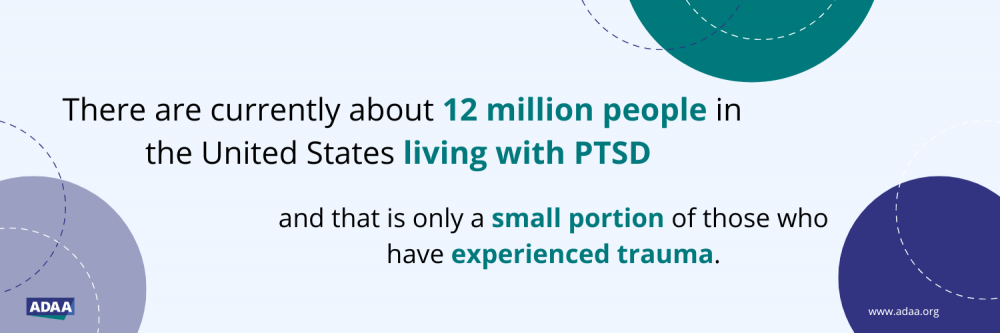
- About 12 million adults in the U.S. have PTSD during a given year. This is only a small portion of those who have gone through a trauma
- About 8 of every 100 women (or 8%) develop PTSD sometime in their lives compared with about 4 of every 100 men (or 4%).
- Women are 2x more likely to develop PTSD than men, and children can also develop PTSD
Children and Teens:
- 15% to 43% of girls and 14% to 43% of boys go through at least one trauma
- Of those children and teens who have had a trauma, 3% to 15% of girls and 1% to 6% of boys develop PTSD
Veterans:
PTSD does not solely affect deployed, active duty military officers. PTSD can affect any unit of special forces such as first responders, the National Guard, or police forces. These statistics are specifically of PTSD in Iraq and Afghanistan Veterans. 10.9% of non-deployed officers and 15.7% of deployed officers develop PTSD2. Access the full range of data about veterans and PTSD here.
Trauma survivors who have PTSD may have trouble with their close family relationships or friendships. Their symptoms can cause problems with trust, closeness, communication, and problem-solving, which may affect the way the survivor acts with others. In turn, the way a loved one responds to him or her affects the trauma survivor. A circular pattern may develop that could harm relationships. Read more from the National Center for PTSD.
ADAA Resources:
- ADAA PTSD Free Peer-to -Peer Support Community
- Defining PTSD and Trauma - ADAA Video
- PTSD Treatment and Support - ADAA Video
- The Symptoms of PTSD - ADAA Video
- What is PTSD? - ADAA Video
- Raising Our Hands: Supporting PTSD Identification, Diagnosis, and Treatment Across Diverse Communities - 2023 On-Demand Webinar
- ADAA Statement on Trauma - 2023
- Traumatic Experiences: Getting Stuck and Unstuck - Blog post
- How to Know if You Should Talk to Your Healthcare Provider about PTSD - Infographic
- Download ADAA's PTSD Brochure
- Is What You're Feeling PTSD? What To Do To Help - Blog Post
- The Aching Red: Firefighters often silently suffer from trauma and job related stress - Blog Post
- MDMA May Help Treat PTSD – but Beware of Claims that Ecstasy is a Magic Bullet - Blog Post
- How to Talk to Your Kids About Violence - Response to the Las Vegas Shootings - Blog Post
- Talking to Children and Teens After a School Shooting - Blog Post
- How to Prevent Trauma from Becoming PTSD - Blog Post
- Healing Invisible Wounds - Webinar
- Trastorno de Estrés Post-Traumático - Webinar
- PTSD: What I Should Know About Current Treatments - Webinar
- Non-Military PTSD - Webinar
Personal Stories:
Additional Resources:
- National Center for PTSD
- PTSD Foundation of America
- Veterans and Civilians Crisis Line Call 1-800-273-8255. Press 1. Text 838255
- Understanding PTSD
Research Resources
- US Department of Veterans Affairs. ptsd.va.gov. PTSD: National Center for PTSD. https://www.ptsd.va.gov/
- US Department of Veteran Affairs. Publichealth.va.gov. PTSD in Iraq and Afghanistan Veterans. https://www.publichealth.va.gov/epidemiology/studies/new-generation/ptsd.asp
- Path to Better Sleep - Veteran Training (va.gov)
- Imagery Rehearsal Therapy to Treat Nightmares With PTSD (verywellmind.com)
- Kunze, A.E., Lancee, J., Morina, N. et al. Efficacy and mechanisms of imagery rescripting and imaginal exposure for nightmares: study protocol for a randomized controlled trial. Trials. 2016;17:469. doi:10.1186/s13063-016-1570-3
- El-Solh AA. Management of nightmares in patients with posttraumatic stress disorder: current perspectives. Nat Sci Sleep. 2018;10:409–420. doi:10.2147/NSS.S166089
- Kunze, A.E., Lancee, J., Morina, N. et al. Efficacy and mechanisms of imagery rescripting and imaginal exposure for nightmares: study protocol for a randomized controlled trial. Trials. 2016;17:469. doi:10.1186/s13063-016-1570-3
- ERRT - ERRT - Kendall College of Arts and Sciences (utulsa.edu)
- Printz Pereira, D. M. B., Grasso, D. J., Hodgkinson, C. A., McCarthy, K., J., Wakschlag, L. S., & Briggs-Gowan, M. J. (In press). Maternal Posttraumatic Stress and FKBP5 Genotype Interact to Predict Trauma-Related Symptoms in Preschool-age Offspring. Journal of Affective Disorders. https://doi.org/10.1016/j.jad.2021.05.042
- Williams, M. T., Printz, D. M. B., & DeLapp, R. C. T. (2018). Assessing racial trauma with the Trauma Symptoms of Discrimination Scale. Psychology of Violence, 8(6), 735-747. http://dx.doi.org/10.1037/vio0000212
- Williams, M. T., Ching, T. H. W., Printz, D. M. B., & Wetterneck, C. T. (2018). Assessing PTSD in ethnic and racial minorities: Trauma and racial trauma. Directions in Psychiatry, 38(3), 179-195.
- Reisman M. PTSD Treatment for Veterans: What's Working, What's New, and What's Next. P T. 2016 Oct;41(10):623-634. PMID: 27757001; PMCID: PMC5047000.
Boost Search Results
On